Painting on wood slices is a simple children’s craft that works for everyone from toddlers making their first colourful marks to older children creating detailed artwork. Most paints, pencils and markers that work on paper will also work on a smooth, sanded wood slice—but the material you choose will affect how much of the natural grain shows through and how precise the finished design can be.
Wood slices are more tactile and unusual than another sheet of paper. Their natural grain, bark edge and individual shape become part of the artwork, while the finished pieces are compact enough to display, hang or give as a gift.
We have made wood slices in the Yarra Valley for more than ten years and have seen them used by families, schools, libraries, art teachers and professional artists. This guide explains which supplies work best, whether the wood needs preparation and how to choose a suitable size.

What can you use to paint or draw on wood slices?
Almost anything that works on paper will work on a smoothly sanded wood slice. This includes:
- Acrylic, poster and watercolour paints
- Paint pens, permanent markers and children’s textas
- Grey lead and coloured pencils
- Biros, crayons and other colouring materials
The main difference is that wood is absorbent and has a visible grain. Some paints sit on top and cover the grain, while thinner paints and inks can soak in or spread slightly.
Acrylic paint
Acrylic is usually the best choice when you want strong, vibrant colour. It provides opaque coverage, generally does not bleed far into the grain and can completely cover the timber beneath it.
It also works better than most other options across the bark edge and on wood slices with a slightly rougher surface. This makes acrylic a good choice for painting our discount wood slice seconds, where the texture, bark and shape may be less consistent.
For young children, choose a water-based, non-toxic acrylic or washable craft paint that is appropriate for their age and follow the manufacturer’s directions.

Watercolour paint
Watercolour creates a softer, more translucent result and allows the natural wood grain to remain visible. This can be a lovely effect when you want the artwork and timber to work together rather than completely covering the surface.
Because watercolour is thinner, it may spread a little along the grain. It is also less effective over bark and on rough or unsanded surfaces. It is, however, easy to clean up and well suited to relaxed art activities where perfect edges are not important.
Paint pens, markers and textas
Pens and markers behave much as they do on paper when used on a smooth, sanded slice. Paint pens are especially useful for fine details, outlines, dots and lettering. Some thinner inks may soak into the grain slightly, so test the pen on a spare slice if crisp detail is important.
Pencils and crayons
Grey lead is useful for lightly sketching a design before painting. Bear in mind that pencil can be more difficult to erase from timber than paper, so keep the lines light and use enough paint to cover them afterwards.
Coloured pencils and crayons also work, although they show up best on smoothly sanded timber. The rougher the surface, the harder it is to create fine or even lines.
Do wood slices need to be prepared before painting?
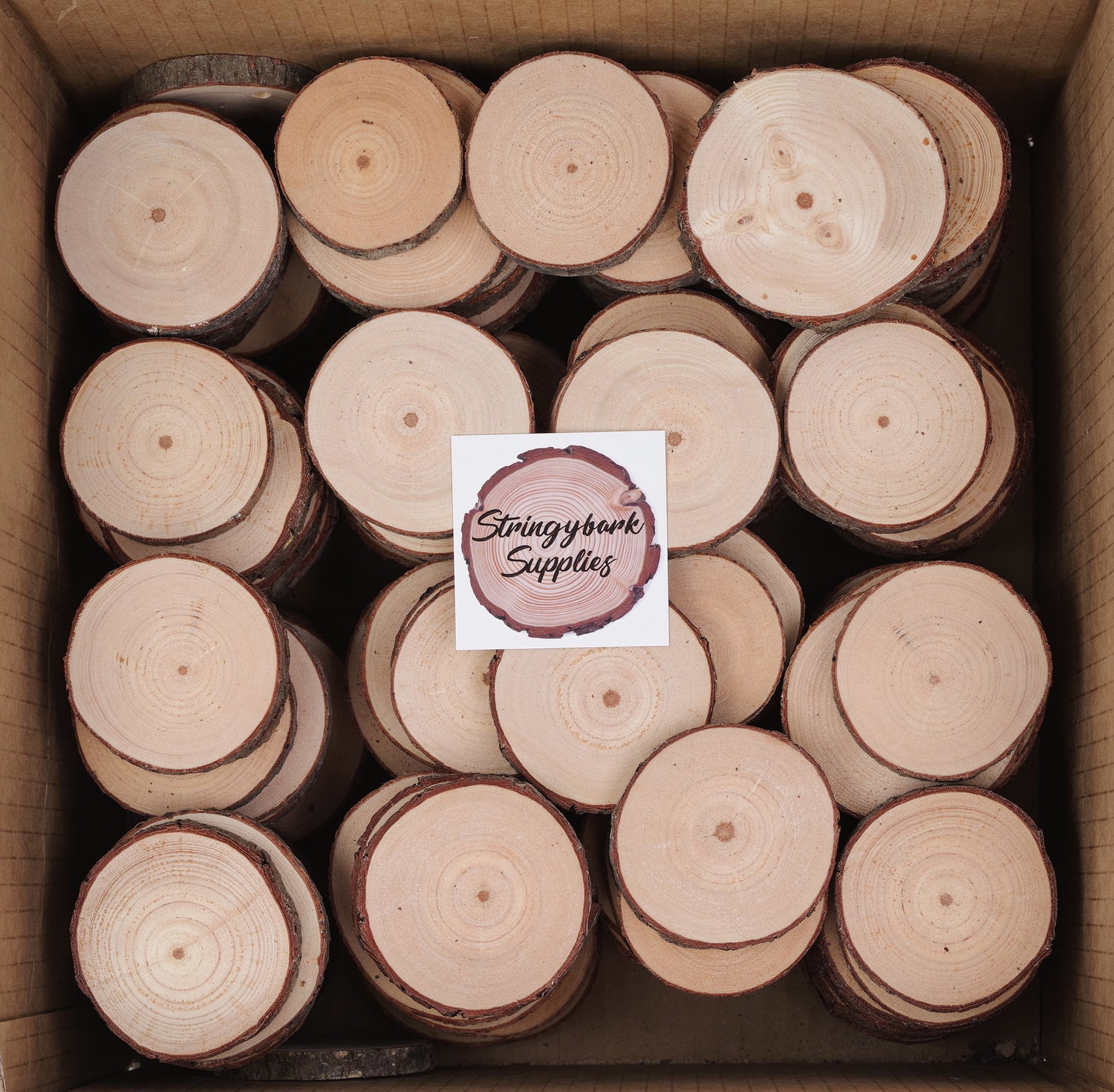
For an ordinary children’s activity, no special preparation is necessary. Our standard Australian-made craft wood slices are dried, sanded and ready to paint or draw on.
If a slice has been stored somewhere dusty, simply wipe the surface with a clean, dry cloth. Further sanding should not normally be required.
When should you seal or prime the wood first?
Priming is optional, but it can help when creating detailed artwork, using a particularly runny paint or making a finished piece for sale. An initial coat of clear gesso or another suitable artist’s primer reduces the absorbency of the timber, helping fine lines remain more precise.
For one detailed piece we commissioned, a professional Yarra Valley artist chose to coat the surface with clear gesso before adding acrylic artwork. It was not essential for the paint to adhere, but it gave her greater control over the finished surface.
If you want very bright colours and do not mind hiding some of the grain, a white acrylic base coat is another option.
Always follow the directions for the primer you choose and let it dry properly. A few hours may be sufficient, but leaving it overnight is the safer option before beginning detailed work.
Do painted wood slices need a top coat?
Not for a casual indoor craft project. Paint generally lasts well on its own.
A compatible clear craft sealer or varnish can make a finished piece more resistant to handling and occasional moisture, which may be worthwhile for gifts, decorations or artwork intended for sale. Let the paint dry fully first and test the sealer on a spare piece, as some products can alter colours or react with certain pens and paints.
Wooden coasters and anything regularly exposed to water require a more thorough, water-resistant finish than a decorative indoor piece.
What size wood slices are best for children to paint?
Around 6–12 cm in diameter is a useful range for children’s painting. It provides a comfortable working area without the slice becoming unnecessarily large or expensive.
A 6–8 cm slice is a particularly good starting point for one-off activities and ornaments. Younger children can still make broad marks easily, while older children have enough room for a simple picture. Choose a larger slice when the design needs more detail.
There is no strict rule, though. Tiny slices can become game pieces, letters or simple faces, while much larger slices can be used for substantial paintings and group projects. Our full wood slice size guide compares all the available sizes and their most common uses.

Which pack should you choose?
- Mixed craft packs are useful when children will experiment with different sizes or you do not yet know which size you prefer.
- Standard same-size packs suit planned projects where every child needs a similar surface or the finished pieces should look consistent.
- Classroom packs provide 100 sanded slices in a selected or mixed size range. The Classroom Craft Wood Slices pack is designed for schools, kindergartens, early learning centres, homeschool groups and other large activities.
- Wood slice seconds offer excellent value when the activity matters more than achieving a matching, retail-quality finish. Their unusual shapes and imperfections can even inspire the artwork. They are less suitable when consistency and a perfectly smooth face are important, although some professional artists deliberately choose them for their character.
- Wood slice sample pack is great to try out wood slices for the first time, especially if you're unsure of the most suitable size. You can find our sample pack here
Hanging holes are available across our standard size range, but not on seconds. Ordering pre-drilled slices is convenient for Christmas decorations, name tags, gifts and hanging displays.
An easy wood-slice painting activity for young children
You do not need to turn this into a carefully managed art lesson. The activity can be adapted to the age, interests and mood of the child.
What you need
- One or more sanded wood slices
- Age-appropriate water-based paints, markers or pencils
- Paintbrushes
- A cup of water for rinsing brushes
- A pencil for optional sketching
- A cloth or paper towel for cleanup
- A table covering and painting clothes if needed
Marcus, the owner of Stringybark Supplies, has done this activity with his own children, currently aged two and five. For a simple afternoon activity, he starts with one 6–8 cm slice each.
The two-year-old is generally happiest experimenting freely and making marks without a set outcome. With the five-year-old, Marcus asks what he would like to paint and may suggest lightly sketching the idea in pencil first. Beyond a few suggestions, the children are free to approach it differently each time.
That same principle works more broadly:
- Toddlers and preschoolers: concentrate on colour, texture and mark-making rather than producing a recognisable picture.
- Younger school-aged children: suggest a simple animal, face, flower, pattern or picture for someone they love.
- Older children: introduce reference pictures, planning and more detailed designs.
Let the finished slices dry flat. They can then be displayed on a shelf or fridge, turned into a game, tied with ribbon through a pre-drilled hole or given as a gift.

Wood-slice painting ideas for children
Mother’s Day and Father’s Day gifts
A child’s painting or drawing becomes a more substantial keepsake when it is made on timber. Add a name, date or short message on the back.
Australian animals and local fauna
We have supplied wood slices for children’s art classes at local libraries where students used pictures of local fauna as drawing references. This works particularly well for older children who are ready to observe shapes, colours and markings more closely.
Christmas decorations
Paint snowmen, stars, animals, patterns or family names on pre-drilled slices, then add ribbon or twine. Children can make a new ornament each year and gradually build a collection.
Noughts and crosses
Create a reusable noughts-and-crosses set by drawing or painting simple symbols onto smaller slices. You could also use two groups of characters, animals or colours in place of traditional noughts and crosses.
Letters, numbers and matching games
Smaller slices can become alphabet pieces, number counters, matching pairs, story tokens or emotion faces. These projects combine art with literacy, numeracy and imaginative play.
Detailed art for older children and adults
Wood-slice painting does not have to remain a children’s craft. Professional artists use our slices for highly detailed and valuable original artworks, with birds being a particularly popular subject. A larger, smoothly sanded slice gives the artist more room, while the bark creates a natural frame around the painting.
Why choose Australian-made wood slices?
Stringybark Supplies makes its wood slices locally in the Yarra Valley from salvaged, introduced pine. The trees are removed from areas where native vegetation can regrow, turning timber that may otherwise be treated as waste into useful craft materials.
Our standard craft slices are carefully dried, sanded and quality-checked before sale. This greatly reduces the cracking and splitting problems often associated with poorly dried, low-cost imported slices. Natural timber will always vary, but starting with properly prepared wood gives children and artists a much cleaner and more dependable surface.
Whether the result is a toddler’s first scribble, a classroom full of Australian animals or a detailed professional painting, the character of the timber makes every piece slightly different.
Frequently asked questions
What is the best paint for wood slices?
Acrylic paint is the best all-round option for strong, opaque colour. It generally covers the grain and bark well and is less likely to bleed than watercolour or thin inks.
Can children use watercolour on wood slices?
Yes. Watercolour works well and allows the wood grain to remain visible, although it can spread slightly and is less effective on bark or rough surfaces.
Do you need to sand wood slices before painting?
Not if you purchase slices that are already smoothly sanded. Stringybark Supplies’ standard craft slices arrive dried, sanded and ready to decorate. Rough or unsanded slices can still be painted, but fine detail is more difficult.
Do you need to prime wood before painting?
Not for most children’s craft. Clear gesso or another appropriate primer is optional for detailed work where controlling paint absorption and achieving crisp lines matters.
What size wood slice is best for painting?
Approximately 6–12 cm works well for most children. A 6–8 cm slice is an economical and versatile starting point, while larger slices provide more space for detailed artwork.
Can you paint the bark?
Yes. Acrylic paint generally covers bark more effectively than watercolour, pencils or thin markers. Bark naturally varies in texture and may absorb paint differently from the smooth face.