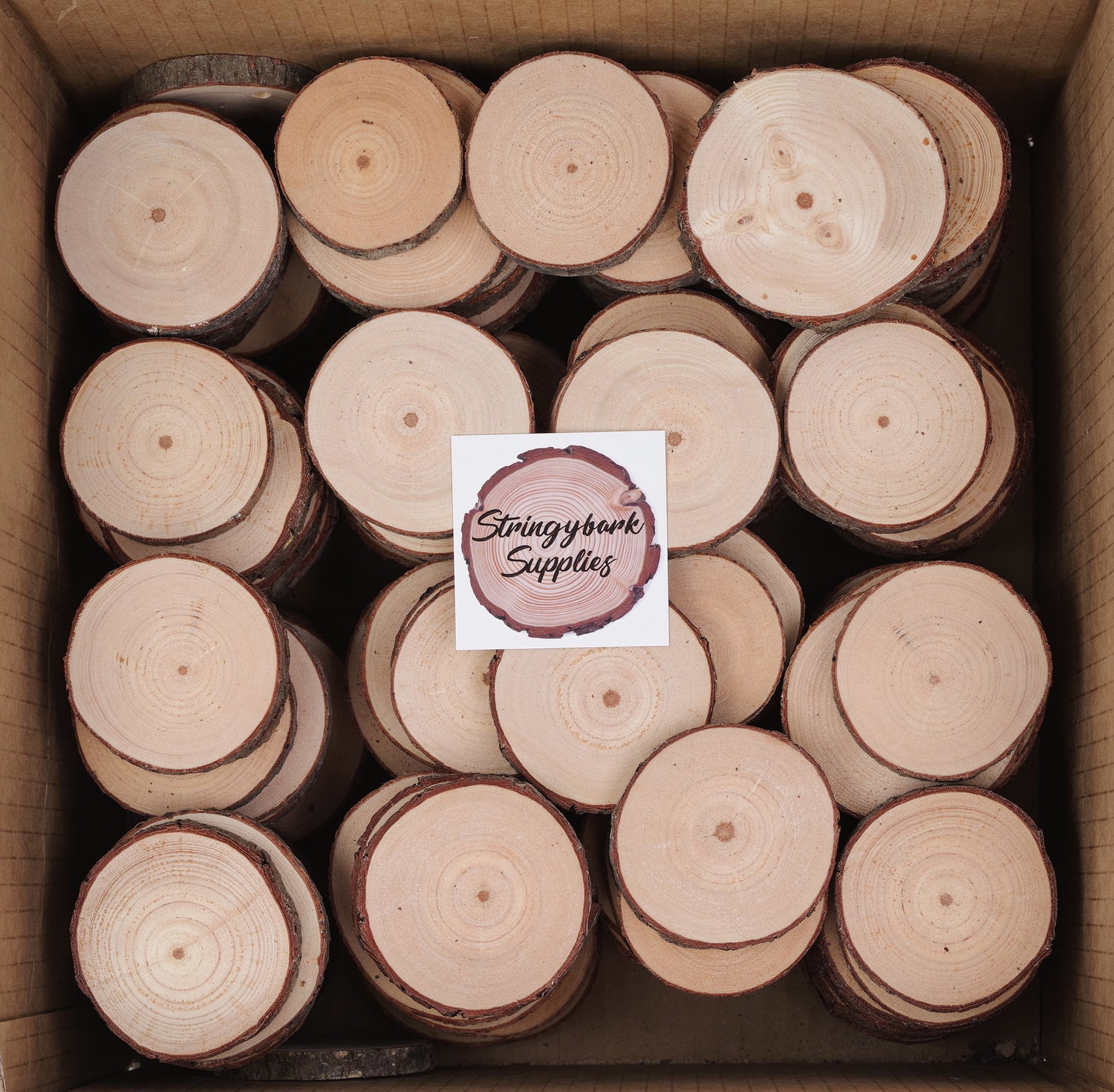
Choosing the size of your wood slices is mostly a question of working space. Small slices are light, economical and useful when you need lots of pieces. Larger slices give children and artists more room to paint, draw or burn a detailed design, but they cost and weigh more.

At Stringybark Supplies, we have spent over ten years refining how natural wood slices are cut, dried and finished. We now produce well over 100,000 slices in a typical year, in sizes ranging from tiny miniature pieces to substantial sawmill-cut rounds.
The quickest guide is:
- Under 6 cm: miniature projects, small-world play, natural play, number or letter counters and small decorations
- 6–8 cm: our most versatile ornament size, with enough room for painting, names and simple artwork
- 8–10 cm: ornaments, painting, pyrography and DIY coasters
- 10–14 cm: larger art blanks for painting, pyrography and detailed craft
- 15–30 cm and larger: centrepieces, displays and substantial art pieces
There is no single best size. The right choice depends on what you want to make, how much working space you need, whether the finished piece will hang, and how many pieces your project requires.
If in doubt, a slightly larger slice usually gives you more room to work. The smaller one wins when you need a lot of pieces and would prefer not to spend the entire craft budget on timber.
Measurement note: Diameter is measured across the face of the slice, including the bark. Because every branch is naturally shaped, measurements are approximate.
Wood slice sizes at a glance
| Approximate diameter | Approximate thickness | Surface | Best suited to |
|---|---|---|---|
| 1–2 cm | Varies | Unsanded | Miniatures, fairy houses, tiny small-world pieces and jewellery components |
| 3–4 cm | 6 mm | Smoothly cut but unsanded | Small-world play, toy stepping stones, stacking, counters and small crafts |
| 4–5 cm | 6 mm | Sanded both sides | Natural play, number or letter pieces, small ornaments, painting and introductory pyrography |
| 5–6 cm | 6 mm | Sanded both sides | Painting, pyrography, ornaments, name tags, story tokens and classroom games |
| 6–8 cm | 8 mm | Sanded both sides | Christmas ornaments, painting, name badges, story pieces and classroom projects |
| 8–10 cm | 10 mm | Sanded both sides | Detailed ornaments, art, pyrography and DIY coasters |
| 10–12 cm | 10 mm | Sanded both sides | Larger paintings, pyrography and oversized coasters |
| 12–14 cm | 10 mm | Sanded both sides | Larger art blanks and detailed adult or classroom projects |
| 15–30 cm+ | 20 mm | Rustic unsanded or sanded both sides | Centrepieces, substantial art pieces and displays |
Thicknesses are approximate. We choose them to balance strength and weight: a slice should be robust enough for its expected use without becoming unnecessarily heavy.
1–2 cm: miniature and fairy-house details
These are specialist miniature slices rather than general art blanks. They work well as tiny stepping stones in a fairy garden, parts of a miniature scene, or details such as a fairy-house door handle. Some customers have also turned them into earrings and other small jewellery components.
Their tiny surface leaves very little room for artwork, and they are unsanded, so choose a larger size if you want an easy surface for painting or pyrography.
Best for: miniatures, fairy houses, small-world details and jewellery components.
Recommended products:
3–4 cm: small-world play and high-volume natural craft
The 3–4 cm range is useful when the number of pieces matters more than having a large drawing surface. Children can stack, roll and arrange them, incorporate them into simple structures, or use them as stepping stones for miniature toys. Their compact size also suits counters for number games, alphabet sets, pattern activities and games such as noughts and crosses.
We supply these slices smooth cut but not sanded.
Best for: small-world play, toy stepping stones, stacking, counters, necklaces and high-volume natural craft.
Recommended products:
4–5 cm: small play pieces with room for simple artwork
At 4–5 cm, there is enough room to introduce simple painting, drawing or pyrography while keeping the slices small and economical. They still work well in fairy gardens and small-world environments, but their sanded faces make them more versatile than smaller unsanded slices.
This size also provides enough room for a clearly written number, letter or simple symbol. A class set can therefore become counting pieces, alphabet tokens, matching resources or reusable game counters.
This size is useful for projects requiring many pieces, particularly when each design only needs a symbol, short name or simple image.
It is also a sensible size when the project involves many children, many pieces, or both — which is often when craft supplies mysteriously disappear faster than expected.
Best for: natural play, number and letter pieces, matching activities, small ornaments, simple painting, introductory pyrography and classroom craft.
Recommended products:
5–6 cm: compact ornaments, painting and pyrography
The 5–6 cm size is a useful bridge between play pieces and conventional craft blanks. It provides noticeably more room for a design while remaining light enough for hanging projects. It is also large enough for a simple character, animal, emotion face or story symbol that children can use in pretend play and storytelling.
One of our repeat school customers orders these every year for students to craft their own name badges.
Best for: painting, pyrography, name tags, ornaments, story tokens, emotion faces and multi-piece classroom projects.
Recommended products:
6–8 cm: the most versatile ornament size
For many buyers, 6–8 cm is the sweet spot. It offers enough space for a name, illustration or painted design without becoming too heavy for a Christmas-tree branch. It is also a practical size for classroom craft because children have a comfortable working area without the cost of a much larger blank.
Best for: Christmas ornaments, painting, name badges, story pieces, classroom projects and medium-size pyrography.
Recommended products:
- 6–8 cm Wood Slices, pack of 10
- Classroom Craft Wood Slices - 100 pack
-
Blank Christmas Ornaments with Ribbon
8–10 cm: artwork, ornaments and DIY coasters
The 8–10 cm range gives artists and children more freedom for detailed designs. It remains usable as a large ornament, although it is heavier than the smaller options.
This size is well suited to coasters. Note that to be suitably water resistant they must be well sealed.
Best for: detailed painting, pyrography, large ornaments and DIY coasters.
Recommended products:
- 8–10 cm Wood Slices, pack of 10
- Classroom Craft Wood Slices 100 pack
- Blank Christmas Ornaments with Ribbon
10–12 cm: generous art space and oversized coasters
Choose 10–12 cm when artwork is more important than keeping the finished piece compact. The larger face is helpful for detailed paintings, pyrography, lettering and designs that would feel cramped on an ornament-sized slice.
These can also become oversized coasters when properly sealed. For hanging projects, consider the finished weight and where the ornament will be displayed.
They can look excellent as larger ornaments, but they are no longer in the “barely noticeable on the branch” category.
Best for: adult artwork, detailed classroom art, pyrography and oversized coasters.
Recommended products:
12–14 cm: the largest of our thinner art blanks
Our 12–14 cm slices continue the small-slice range: they are approximately 10 mm thick, sanded on both sides and intended primarily as large art blanks. They offer a generous face without the weight or cost of a thicker sawmill-cut slice.
There is some diameter overlap with our smallest large wood slices. Choose the thinner 12–14 cm option when you want a larger version of a conventional craft slice. Choose a sanded 20 mm sawmill slice when you want a more substantial, thicker piece.
Best for: larger paintings, detailed pyrography and substantial art projects.
Recommended products:
15–30 cm and larger: centrepieces and substantial art pieces
Our large wood slices are cut on a sawmill to approximately 20 mm thick. We offer two principal finishes:
- Rustic pine wood slices retain the rough sawmill-cut surface and are particularly well suited to table centrepieces and event styling.
- Sanded pine wood slices are sanded on both sides for painting, drawing and pyrography.
We find customers often buy in the 17–23 cm, or 7–9 inch, range for small centrepieces, and up to 30 cm, or 12 inch, for more substantial centrepieces.
For painting, a larger surface is usually easier to work on. Schools also purchase these thicker sanded slices for individual art projects; they are not limited to wedding and event use.
Requests for very large but very thin slices do come up from time to time. In practice, timber, drying and physics all get a vote.
Best for: table centrepieces, event styling, substantial paintings, pyrography and display pieces.
Recommended products:
Which size should you choose for a particular project?
Children's painting
Larger slices give children more room, but the ideal size depends on budget and whether each child receives one piece or several. Around 6–10 cm is a practical starting point for a single painted item. Smaller slices suit multi-piece activities, while 10–14 cm and sanded large slices provide more room for individual artwork.
Some schools maintain a communal supply rather than allocating one slice to every child. For that approach, a bulk or mixed-size pack gives teachers flexibility across different activities.
Maths, literacy and classroom games
Small wood slices can become reusable learning pieces when an educator adds numbers, letters, words, colours or symbols. Published classroom and home-learning examples include:
- Ordering numbers and constructing number lines
- Combining individual digits to make two- and three-digit numbers
- Counting and simple arithmetic games
- Alphabet recognition and spelling
- Matching colours, letters, quantities or symbols
- Noughts and crosses and other counter-based games
- Story prompts, characters and emotion faces
Around 3–6 cm is practical for a single number, letter or game symbol. Use 5–8 cm when children need to read a word, recognise a detailed picture or handle a larger story token.
These ideas are documented by education and play-based learning writers, including Childsplayabc's log-slice activities, The Imagination Tree's wooden number activities and Rainy Day Mum's number game. The most appropriate activity and level of supervision will depend on the children and learning environment.
Sorting, patterns and open-ended play
A mixed-size pack can be used without turning every slice into a permanently labelled resource. Children can sort pieces by size, colour, grain or shape; arrange repeating patterns and sequences; compare quantities; build paths or structures; or combine the slices into temporary pictures and designs.
This is often described as loose-parts play: the pieces do not have one predetermined outcome, so children can reinterpret and rearrange them. General early-learning guidance also uses loose parts for sorting, measurement, pattern recognition, symbolic storytelling and open-ended construction.
Adult painting and pyrography
Choose the largest sanded slice that suits the design and budget. A 10–14 cm slice is a useful art blank, while thicker sanded slices offer more space and a more substantial finished object.
Christmas ornaments
Approximately 4–10 cm works well. Choose 4–6 cm for small, light decorations; 6–8 cm for a versatile balance of working space and weight; or 8–10 cm for a larger statement ornament. Blank Christmas ornaments with ribbon are available in several of these sizes.
Name badges and hanging tags
Approximately 5–10 cm works for most name-badge designs. If the finished piece needs string or ribbon, ordering pre-drilled slices saves time, particularly for schools and large groups.
Our drilled holes are generally about 6 mm wide and positioned approximately 1 cm from the edge, with smaller holes or closer placement used when necessary on very small slices.
Small-world play
Use slices under 6 cm for miniature stepping stones, stacking, rolling, patterns and building small structures. A mix of sizes gives children more options for paths, towers, platforms and temporary pictures. These are stepping stones for toys and miniature scenes, not outdoor stepping stones for people.
Coasters
Approximately 8–11 cm is the most practical range. Seal blank slices thoroughly before exposing them to moisture, or choose a product made and finished specifically as a coaster.
Table centrepieces
Choose from the large wood slices section. Most couples choose the rustic pine wood slices as they maintain their rustic look and are at a lower price point than the sanded alternative. Any size from this range will add rustic presence to your tables. The larger the size, the more room you have for flowers, candles or other display pieces on top of the base.
Feature walls
Feature walls can use one size or a mixture. Our feature-wall kits use approximately 3–6 cm slices as they create a nice even appearance with few gaps. Many customers also order smaller quantities of larger wood slices to add variety to the wall. We are able to customise our feature-wall kits to whatever sizes you need.
Still unsure which size to order?
We have a sample pack which includes 7 wood slices within a range from 3–14 cm. That way you can try your project with each size and better gauge which is most suitable.

If you're looking at sizes larger than 14 cm, often the best way is to use a ruler to measure plates or bowls you have at home to get a feel for how large you need. Failing that, use a ruler to draw a circle on a piece of paper or cardboard.
It is not glamorous, but it is surprisingly effective. A circle drawn on scrap cardboard can save a lot of second-guessing.
If you need help with an unusual application or a large order, contact Stringybark Supplies at marcus@stringybarksupplies.com. We can provide product guidance, formal quotes, tax invoices and assistance with school or organisational purchasing requirements.