Wood slices can be an environmentally responsible craft material—but simply being made from wood does not automatically make a product eco-friendly.
A tree still had to come down. The important questions are what species it was, why it was removed, how much of the tree was used and what happened between the tree being collected and the finished product reaching the customer.
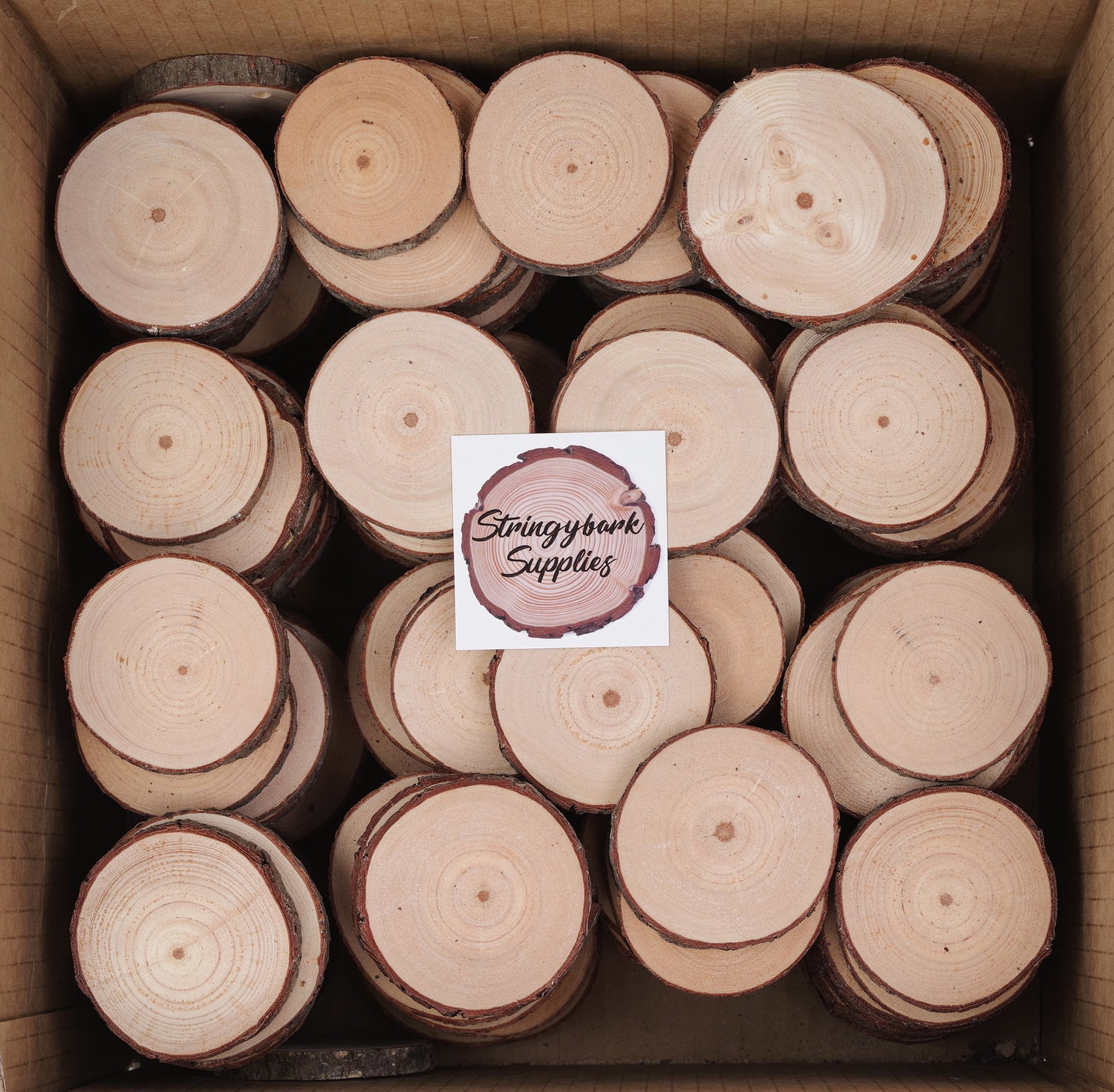
At Stringybark Supplies, we make our wood slices locally in the Yarra Valley from timber whose source we know. Most comes from introduced radiata pine growing where native bushland is intended to be, while occasional native timber is used only when the tree has already fallen or is being removed for another reason.
Where our timber comes from
Most of our smaller wood slices are made from radiata pine removed from land beside a commercial pine plantation.
Radiata pine is useful plantation timber, but trees that spread beyond plantation boundaries can become an environmental weed. Yarra Ranges Council explains that radiata pine can invade bushland, compete with indigenous vegetation for moisture, nutrients and light, and smother smaller plants with fallen needles. You can read more in the council’s radiata pine information.
The land we source from is leased by the plantation operator but is intended to remain native bushland. The operator is required to remove the pines growing there, and we collect them with its permission.
Native vegetation is not actively replanted after we remove the pines. However, in our experience, once the heavy shade and layer of pine needles are gone, native plants begin returning surprisingly quickly.
Our large pine wood slices generally come from private landowners who have already decided to remove a tree. Sometimes we carry out the removal ourselves; in other cases, the landowner arranges for the tree to be cut down and we collect the timber afterwards.
We occasionally offer native species such as eucalyptus or wattle. We do not cut down healthy native trees simply to manufacture wood slices. This timber comes from trees already being removed for reasons such as powerline clearance, or from fallen trees where collecting the timber is appropriate.
We use almost the entire tree
Making a useful product from a removed tree is only part of the picture. We also try to use as much of each tree as practical.
Suitable sections become our standard wood slices. Pieces with unusual shapes, missing bark, uneven cuts or other imperfections are offered as discount wood slice seconds rather than discarded.
The small amount of timber unsuitable for either product becomes firewood for our home. Our sawdust is always popular when we list it on Facebook Marketplace as it's made from real wood not particle boards like mdf and plywood which also contains glues. The sawdust is collected by local residents for uses including garden paths, mulch, compost and composting toilets, and we use some in our own compost. None of our timber or sawdust is sent to general waste.
Only the smallest branches are left where the trees are removed, allowing them to break down naturally on site.
Made locally and left natural
Every stage of production takes place at our factory in Wesburn in the Yarra Valley. We collect the timber, cut it into slices, dry it, sand it where required, and pack the finished products ourselves.
Our blank wood slices are untreated and uncoated. We do not add preservatives or protective chemicals, so customers receive natural timber ready for painting, drawing, pyrography, resin art and other craft projects.
Orders are packed primarily using cardboard boxes with either crumpled paper or plant-based void fill. We do not use plastic bags or plastic cushioning. At the time of writing we do still use plastic based tapes as in our trials with recycled tape the adhesion was inconsistent and not suitable for our products which can be reasonably heavy. Plastic packaging tape can still be placed in the recycle bin with the box when finished with it.
You can see more of the steps involved on our About Stringybark Supplies page.
Do wood slices store carbon?
Wood continues to hold some of the carbon absorbed by the tree while it remains intact. Turning suitable timber into a useful product can therefore delay the release of that carbon into the atmosphere.
While the overall carbon locked in wood slices is tiny compared to other industries it does make up one small part of the product’s overall environmental story.
What should you look for when buying wood slices?
Country of origin is not the only measure of environmental impact, and an imported wood slice is not automatically unsustainable. The larger issue is often traceability. Many mass-produced craft slices provide little information about:
- The tree species
- Where the tree grew
- Why it was harvested
- Where the slices were manufactured (and how much fuel was consumed in transport between manufacture and end destination)
- Whether preservatives or coatings were added
- How much timber and packaging became waste
We think customers should be able to ask those questions and receive straightforward answers.
Our Australian-made wood slices are produced from known local timber, made entirely at our Yarra Valley factory and supplied without added coatings or preservatives unless a product description clearly states otherwise.
So, are wood slices eco-friendly?
They can be a responsible choice when they are made from appropriately sourced timber, used efficiently and produced with minimal waste. But no product becomes sustainable simply because it is natural or made from wood.
For Stringybark Supplies, the important points are practical and specific: most of our timber comes from introduced pines already required to be removed from native bushland; healthy native trees are not felled specifically for our products; almost the entire tree is used; and every wood slice is made locally by us.
That is the environmental difference we are comfortable standing behind.